Why a network with no central node keeps data moving when radios are lost, terrain gets in the way and the spectrum is jammed.
The problem with a single path
Most data links in service were designed as point-to-point or star networks: one ground station talks to one aircraft, or one hub talks to every node. That architecture is simple to plan and easy to certify, but it has a structural weakness. Every message depends on one specific radio and one specific path. If the hub is destroyed, jammed or simply blocked by terrain, every node behind it goes silent at once.
In a contested environment that weakness is predictable, and therefore exploitable. A central node is the obvious target for a jammer or an emitter locator, and the line of sight it depends on is the first thing that terrain, buildings or distance take away.
What a mesh network does differently
In a mesh, every node is both an endpoint and a router. Each radio forwards traffic for its neighbours, so a message can reach its destination over several hops, through whichever nodes happen to be available. There is no master node and no single path. In military usage this is often called a mobile ad hoc network (MANET): the nodes move, the links between them come and go, and the network keeps reorganising itself around what is left.
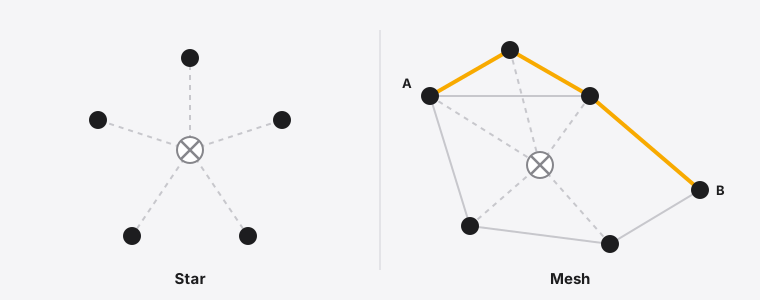
Three properties follow directly from this design:
- No single point of failure. Losing a node removes its own traffic, not the network.
- Range beyond line of sight. Two nodes that cannot see each other can still communicate through a third node that sees both, for example a UAV acting as an airborne relay for a ground team behind a ridge.
- Growth without a bottleneck. Each new node adds paths and relay capacity instead of adding load to a hub.
How the network finds and heals its routes
Every node continuously measures the links to its neighbours: signal quality, error rate and available throughput. A routing protocol turns those measurements into paths. Proactive protocols keep a route to every destination up to date at all times, so forwarding is immediate but the network carries more control traffic. Reactive protocols look for a route only when one is needed, which saves overhead but delays the first packet. Tactical systems generally balance the two, refreshing routes often enough that a failed link is bypassed quickly.
Routing can work at Layer 2 or at Layer 3. Layer 2 forwarding makes the whole mesh look like a single Ethernet segment, so cameras, flight computers and ground stations connect without any change to their configuration. Layer 3 routing works with IP subnets and scales better to large networks. A radio that supports both lets the integrator choose for each deployment.
When a node disappears, its neighbours notice the missing link, the routing protocol recalculates and traffic moves to the next best path. That is what self-healing means in practice: not that nothing is ever lost, but that the network recovers without an operator touching it.
The cost of every hop
Mesh networking is not free. On a shared channel a radio cannot transmit and receive at the same time, so a relay has to receive a packet before it can pass it on. Every additional hop therefore reduces the throughput available end to end and adds latency. On a simple chain, the first relay alone roughly halves the usable rate.
This is why mesh performance depends on planning as much as on the radio: placing relays where they shorten the path, keeping the hop count low for high-rate traffic such as video, and adapting the waveform on each link separately. A strong, short link can run a dense modulation such as 256-QAM while a long, weak one falls back to QPSK or BPSK. The network as a whole then carries far more than it would if every link used its most robust setting.
MIMO: more than one antenna per link
Low-altitude and urban links suffer from multipath: copies of the signal arrive by different routes and cancel each other out at certain points. MIMO radios use two or more antennas at each end of the link. When the channel is poor, they use the antennas for diversity, combining the copies so that a fade on one path is covered by another. When the channel is good, they use them for spatial multiplexing, sending separate streams in parallel to raise throughput. In a mesh this matters at every hop, because each hop is a radio link with its own multipath.
Mesh under jamming
A jammer has to overpower the wanted signal at the receiver. A mesh radio can make that harder in several independent ways:
- Spreading. Direct-sequence spread spectrum (DSSS) spreads each bit across a much wider band. Despreading at the receiver recovers the wanted signal and leaves a narrowband jammer spread out and weak. The advantage is the processing gain, Gp = 10 log10(chip rate / bit rate): spreading at one hundred times the data rate gives 20 dB.
- Moving. Frequency hopping (FHSS) changes channel faster than a follower jammer can retune, and an interference-aware hopping pattern stays away from channels that are already occupied.
- Transmitting quietly. Adaptive output power keeps each link only as loud as it needs to be, which lowers the probability of being detected and located in the first place.
- Routing around. A jammer degrades the links closest to it. In a mesh, traffic can take a path through nodes that are further away. With no master node, there is also no single radio whose loss would take the network down.
None of these is sufficient on its own. Together, they turn a single jammer from a mission-ending event into a loss of margin.
Where tactical mesh is used
- UAV teams that share video and telemetry and relay for one another.
- Convoys and dismounted teams moving through terrain that breaks line of sight.
- Airborne relays that connect ground units to a command post beyond the radio horizon.
- Test ranges, where several instrumented platforms report to one ground segment at the same time.
How Bridge applies it
RFBIT’s Bridge data links are built as a centerless MIMO mesh: no master node, Layer 2/3 dynamic routing and multi-hop relay, in point-to-point, point-to-multipoint and multipoint-to-multipoint configurations. Every model, from the 2 W airborne unit to the 20 W ground node, joins the same mesh. Against jamming, Bridge combines DSSS, frequency hopping across 400 MHz to 6 GHz with a 1 ms hop time, and software-adjustable output power. In live testing, a Bridge-equipped aircraft flew over an active 100 W jammer in DSSS mode without a single dropout.